
Introduction: Who is Bora Chung?
Bora Chung is a South Korean novelist whose bold, imaginative storytelling has captivated readers around the world. Best known for her short story collection Cursed Bunny, Chung blends elements of horror, science fiction, folklore, and satire to examine themes of gender, power, capitalism, and trauma—all through a distinctly Korean lens.
Originally published in Korean in 2017, Cursed Bunny gained international acclaim after its 2021 English translation by Anton Hur was shortlisted for the 2022 International Booker Prize, a first for any South Korean work in that category. The book’s genre-defying style, often described as “literary horror” or “surrealist feminist fiction,” helped introduce Korean speculative literature to a wider global audience.
Scholar, Translator, and Activist
Born in 1976, Bora Chung holds degrees from Yale University and Indiana University, where she specialized in Slavic literature. She has translated numerous works from Russian and Polish into Korean, including the writings of Andrei Platonov and Bruno Schulz. Her academic and multilingual background enriches the layered narratives in her own fiction.
Beyond literature, Chung is also known for her longstanding commitment to social justice and labor rights. She has participated in progressive activism for years, advocating for marginalized communities in South Korea and often aligning herself with feminist and labor movements. These values frequently surface in her writing—whether through critiques of patriarchal structures, economic inequality, or institutional violence.
Lawsuit and Debate about Temp Workers’ Plight
In 2022, Bora Chung filed a civil lawsuit against Yonsei University, where she had taught Russian language and literature as a part-time instructor from 2010 to 2022. She sought payment of various allowances, including severance pay, weekly holiday pay, and annual leave compensation, based on her employment status.
In 2025, the Seoul Western District Court’s Civil Division 3 ruled partially in her favor, ordering the university to pay approximately 33.51 million KRW.
In this notable case, the judge concluded that Chung did not qualify as an “ultra-short-time worker”—defined as someone working fewer than 15 hours per week—and was therefore eligible for severance pay. The ruling cited a 2023 Supreme Court precedent that acknowledged university lecturers’ class preparation time as compensable labor. Based on that standard, the court held that total working hours should be calculated as three times the number of weekly teaching hours.
A New Voice in Korean Literature
Though she spent much of her early career outside the literary spotlight, Cursed Bunny propelled Chung into international recognition. Stories like “The Head,” “Snare,” and “The Embodiment” mix grotesque imagery and deep psychological insight to explore bodily autonomy, exploitation, and revenge—recurring themes that echo her activist concerns.
Chung’s rise reflects a growing global interest in Korean literature that breaks from convention. Her fusion of the speculative, the political, and the personal has established her as one of the most distinctive literary voices in Korea today.
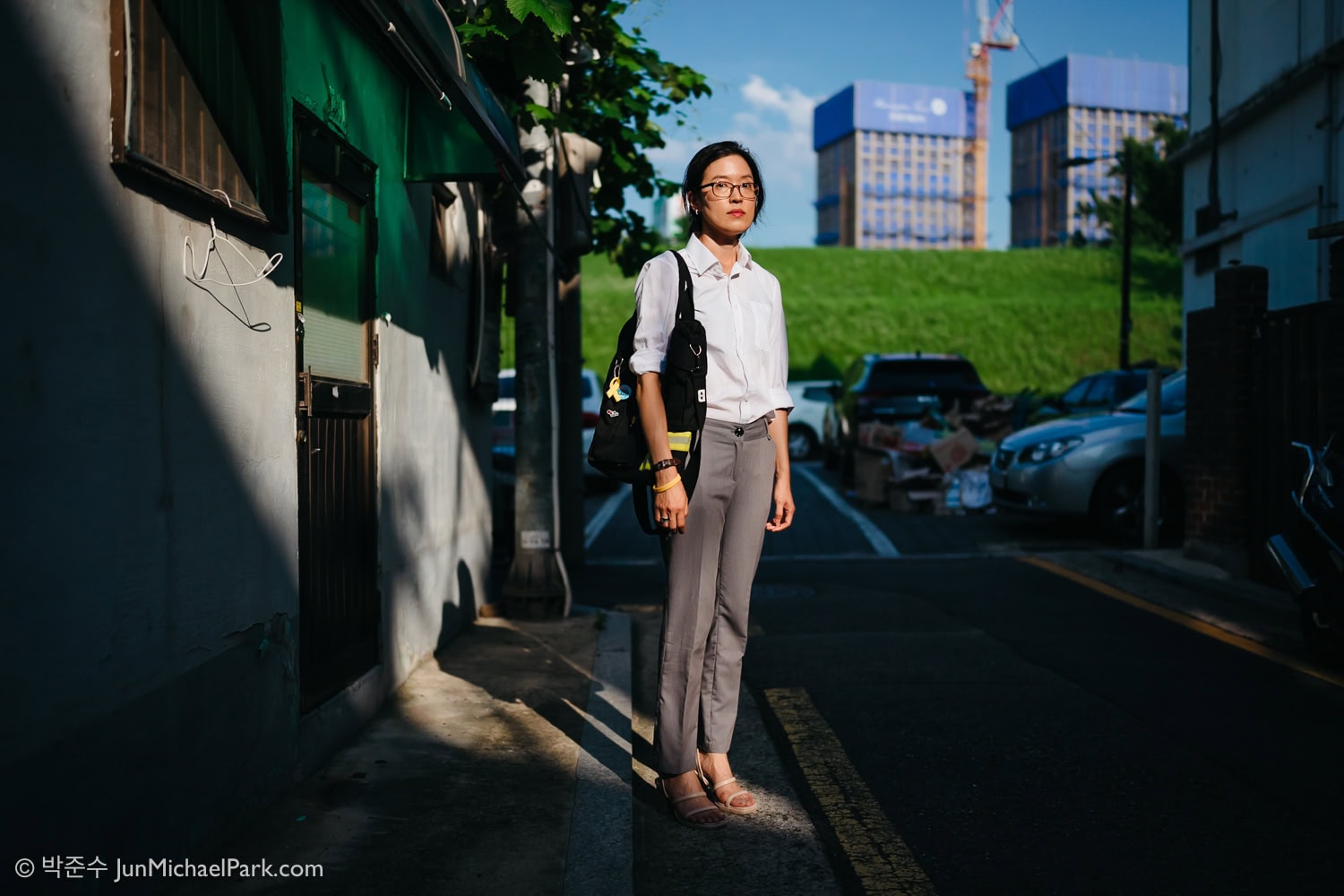
Authentic Photographs of Bora Chung
I photographed Bora Chung in the summer of 2022 for Morgenbladet, Norway’s oldest daily newspaper. Please see my photographs and contact me for licensing inquiries.